Why Traditional Advertising Burns Through B2B Budgets
Classic advertising logic doesn't match the B2B buying process. We look at where the money leaks out, and what you can do instead to win customers efficiently.
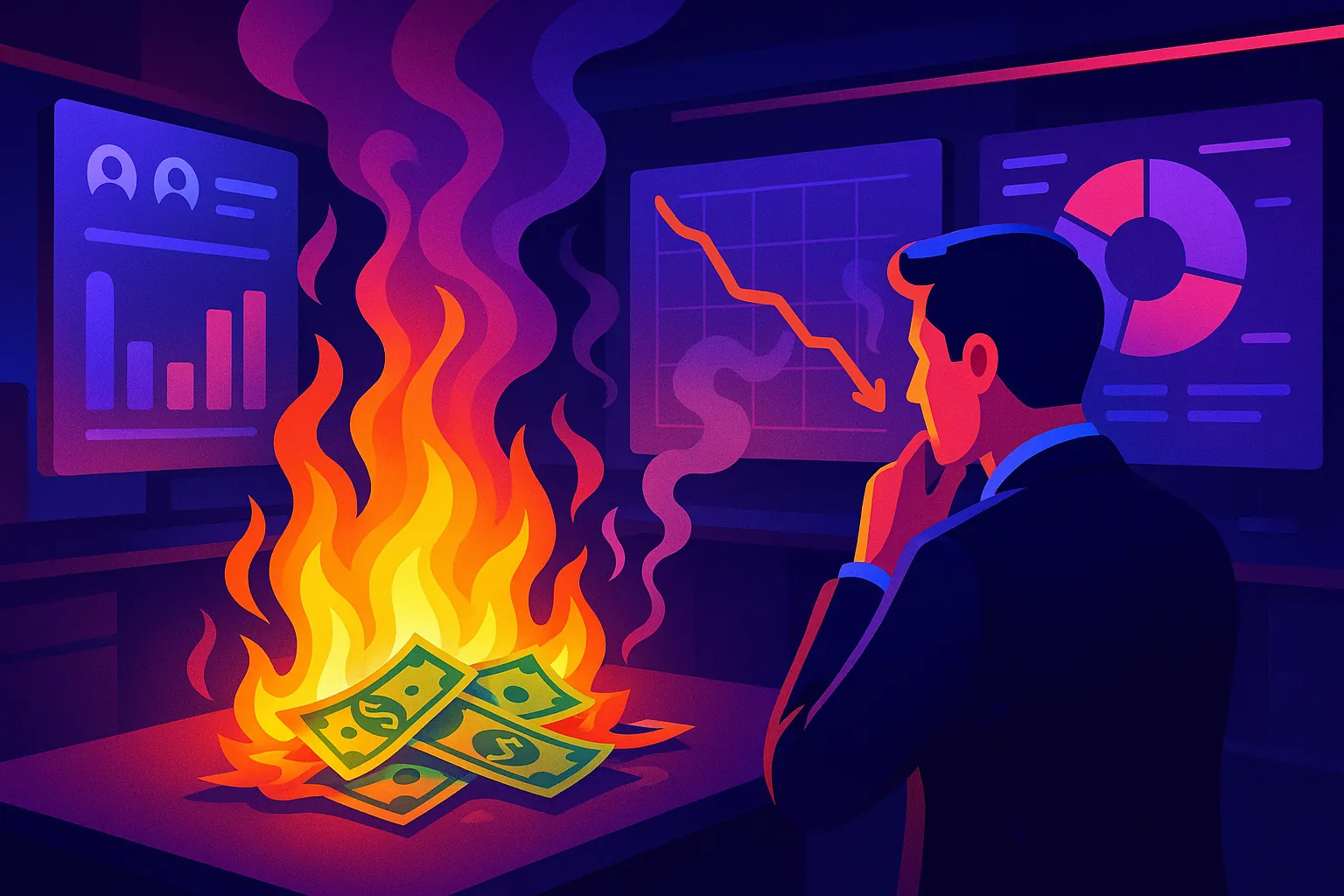
Most B2B companies (businesses that sell to other companies and corporate clients) that work with a serious marketing budget eventually run into the same painful realization: a large share of the money spent on ads simply vanishes, with no measurable business result behind it. Not because advertising is a bad channel, but because the classic B2C playbook (the one built for consumer markets) doesn't work when you force it onto the corporate world.
In this article we'll walk through why the money leaks out, where the most common loss point sits, and what sensible principles you can use to reshape an ad budget so that you spend your money on customers, not on campaigns.
Why is the B2B buying decision different?
A B2B purchase is rarely impulsive. A decision-maker doesn't glance at an offer three times and add it to a cart over their lunch break. The process takes weeks, often months, involves several people, and usually follows a formal procurement path that has to be respected.
This means advertising plays a different role here than it does in consumer markets. The goal isn't immediate conversion (a purchase), but to make sure your company is in the decision-maker's mind during those few hours in a given week when they happen to be thinking about the problem. Anyone who tries to hit that delicate timing with classic click-based advertising is, statistically, guaranteed to lose a big chunk of their budget.
Where does most of the money leak out?
An ad budget drains fastest at three classic points in a B2B company:
- Targeting that's too broad. The B2B segment rarely scales to audiences of 50,000, and classic interest or demographic targeting can't tell an engaged decision-maker apart from a bored middle manager.
- An irrelevant landing page. If the campaign lands on a generic homepage, the prospect is lost in seconds. B2B attention is short and expensive.
- No tracking after the click. Most campaigns measure up to the visitor, not to the sale. So you never find out which channel brings real business and which just generates traffic.
The measurement illusion of advertising
Ad platforms measure themselves astonishingly well. Opens, clicks, impressions, cost: every number can glow green while nothing moves in the company's bank account. That's no accident. The platform measures its own performance, not your revenue.
That's why a B2B ad KPI (metric) is misleading on its own. The real indicators are the meeting, the proposal, and the signed contract. If the ad platform's numbers are rising but these aren't, then the campaign isn't working, it just looks like it is.
What can you do instead?
In B2B, the fastest return comes from not leaving outreach to chance or to an algorithm, but from addressing the decision-maker directly. The sensible form of this is targeted, personalized contact: a specific message to a specific person at a specific company.
Personal outreach, however, has two serious pitfalls. One is that it's time-consuming - an in-house team member can send at most a few dozen genuinely personalized emails a day. The other is that if the bulk outreach goes out from your main company email account, it ruins the domain's reputation (the sender's trustworthiness in the eyes of email providers), and your company's normal correspondence suffers too.
Where does managed B2B email outreach come in?
This is where the question can be reframed: instead of spending on a hard-to-measure awareness campaign, you put the budget into a more targeted, more measurable channel. A managed B2B email outreach service fills exactly this gap: it researches the decision-maker recipient by recipient, sends a personalized introductory email, and leaves your own main email account untouched.
A conversation started this way is measurable (who we contacted, who replied), controllable (it can be switched on or off per campaign), and has a predictable cost up front. The marketing budget goes toward something that produces new customer conversations, not just reports made of impressions.
Summary
In B2B, advertising doesn't burn money because the creative is bad or the setup is wrong. It burns money because classic advertising logic and the B2B buying process barely meet. If we're honest with the numbers, then when planning the next ad budget it's worth asking a single question: with this money, do we want to meet a customer, or do we just want to see traffic in the report?
If the first is the goal, and you're curious what a controlled, managed B2B email outreach looks like in practice, take a look around b2brelay.com and let's start with an introductory conversation.

Kapás Bence
Founder · operator, b2bemail
Our clients' B2B outreach runs on a system I built: it researches the decision-makers, drafts a personalized email for each recipient, and tracks every reply that comes back. My role is oversight — I review the campaigns daily, and the judgment calls stay with me and the client.
Learn more about the serviceLet's talk about your own campaign.
On a 30-minute intro call we'll look at who's worth reaching and what you can realistically expect.
Book a call